


Béatrice Collignon, Geographer
• Associate Professor – Geography Dept., Université Paris 1 Panthéon-Sorbonne
• Research Lab : Géographie-Cités (8504 - CNRS/U. Paris 1/U. Paris 7) – Group EHGO (Epistemology and History of Geography).
• Beatrice.Collignon@univ-paris1.fr / 06.16.49.82.10
Region where research with the Inuit is conducted
Inuinnait region (Western Kitikmeot, Nunavut and North-Western coast of Victoria island, NWT). Communities of Ulukhaktok (main research base) and Kugluktuk, as well as Cambridge Bay (but have not conducted research there since 1992, only went back once in 2006).
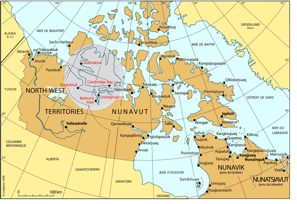
I have conducted research in this area since 1986, my 1st experience of the Arctic going back to the summer of 1980 when, as a teenager, I joined an archaeological dig approx. 20 miles East of Ulukhaktok. The most interesting for me was not the archaeology but meeting with Inuinnait teenagers who also participated in the dig and travelling with them each evening or so to visit relatives’ camps set close-by.
Research topics explored with the Inuinnait
Previously, and continuing : Geographic knowledge (of the Inuinnait) ; Indigenous Place names and Toponymy ; Domestic spaces (of today and yesterday)
Projects for the coming years : Changing local landscapes in relation with climate change ; Contemporary mobility within the Canadian Arctic (between communities) and beyond (Southern Canada, other arctic regions, non arctic foreign countries) => where “mobility” refers to trips and stays of various length rather than moving “ permanently” to a different place.
About the research methodology
a) Formal and informal gathering of data
I have always relied heavily on informal discussions rather than formal interviews, and on rather intense participation in the communities daily life and activities.
Formal interviews were only conducted for two projects :
• the Inuinnait Place Names survey (1991-1992), conducted as part of my PhD research on Inuinnait geographic knowledge
• Inuinnait domestic places (1998-2000), for which 9 elderly women were formally interviewed, and video-taped, in Kugluktuk and Ulukhaktok in April 98.
Future projects would include some formal interviews, as well as a short questionnaire for the research on contemporary mobility.
) b) Framework : partnership with the communities ?
Althought all projects were always approved by the local communities and benefitted from strong support and participation, I never went as far as developping them within the framework of a formal partnership with the local communities, for a number a reasons (mainly : lack of infrastructure and work force on both sides, lack of time to look for funding for what automatically becomes a large, or larger, project). Sharing of research was done following other ways, which we, on both sides, believe worked quitte well.
In the future, it is obvious the project on Changing local landscapes requires formal partnership.
Publications in English on these topics
➢ 2011, “Domestic spaces and cultural geography”, in L. Mercatanti ed, Percorsi di geografia. Tra cultura, società e turismo, Bologna, Pàtron, p. 233-244.
➢ 2009, ed with Therrien M., Orality in the 21st century : Inuit discourse and practices, Proceedings of the 15th Inuit Studies Conference, Paris, INALCO, on-line publication (and on CD-Rom), http://www.inuitoralityconference.com.
➢ 2008, « ‘Urban context’, ‘Urban life’, ‘Urbanity’ : What is a City after all ? Geography’s Basics on the Object ‘Urban’ », in F. Sejersen, K. Thisted et S. Thuesen eds, The Urban Arctic. Living Communities : New Perspectives on Inuit Urban Life, Copenhagen, Eskimology and Arctic Studies Section / IPSSAS, p. 9-16.
➢ 2006, Knowing Places. The Inuinnait, Landscapes and the Environnment, Edmonton, CCI Press, (Canadian Circumpolar Institute, University of Alberta), Research Series 10, 304 p.
➢ 2006, "Inuit’s Place Names and Sense of Place", in P. Stern and L. Stevenson eds, Critical Inuit Studies : an anthology of contemporary arctic ethnography, U. of Nebraska Press, Lincoln, p. 187-205.
➢ 2004, "Housing", "Inuvialuit", "Place names", "Victoria Island", in M. Nuttall ed, Encyclopedia of the Arctic, London, Routledge, p. 877-878 ; p. 1008-1010 ; p. 1646-1648 ; p. 2130-2131.
➢ 2004 ; “it’s a long way to the ‘Other’ : Geographers and geographic knowledge”, Geojournal, 60-4, p. 375-379.
➢ 1993 ; 1993, "The variations of a land use pattern : Seasonal movements and cultural change among the Copper Inuit", Etudes / Inuit / Studies, Québec, l17-1, p. 71-89.
Video documentaries – filmed and edited by B. Collignon
➢ 2007, Mary’s qulliq, Paris, UFR de géographie - Atelier GéoVidéo U. Paris 1, 7’ – in Inuinnaqtun only.
➢ 2006, Putting Inuinnait place names on the map, Paris, UFR de géographie - Atelier GéoVidéo U. Paris 1, 14’ – in English (with a bit of Inuinnaqtun)
➢ 2001, From igloos to 3-bedrooms houses, reflections from Inuit elders, Paris, UFR de géographie - Atelier GéoVidéo U. Paris 1, 18’ – in English and Inuinnaqtun with English sub-titles.
Major publications
LES INUIT, CE QU’ILS SAVENT DU TERRITOIRE
Béatrice Collignon
Géographie et cultures - Etudes culturelles et régionales
GÉOGRAPHIE
Cet ouvrage porte sur la géographie des Inuit du Canada : comment ils s’orientent, comment ils nomment les lieux, de quelles valeurs ils les investissent. Tout cela constitue un savoir géographique très élaboré mais rarement explicité. C’est en fouillant dans la tradition orale, en observant les pratiques (pêche, chasse, déplacement) en analysant la toponymie que l’on découvre un ensemble complexe de connaissances. Cet ouvrage nous démontre que l’art du territoire n’est pas seulement une affaire de survie. Il est également l’expression de l’épanouissement d’une culture.