


Text and photos : Jascivan Carvalho
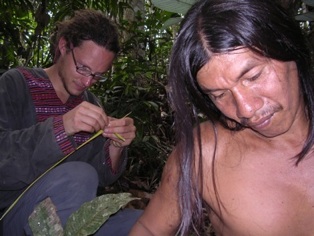
The Huaorani (sometimes written "Waorani") are a timeless tribe. Their origins are unknown and their language (Huaorani translates as "The People") has no relation to any other known tongue. For thousands of years they have made their home in the lush forests of the Amazon, moving silently through the jungle, living amongst the animals and plants, leaving little trace of their presence.
"The People" still maintain their traditional lifestyle. But unlike some closely related tribes, who shun outside influences and can be dangerous to approach, they are no longer nomadic hunters. The Huaorani now lead a more settled and open existence in the humid tropical forests of Ecuador.
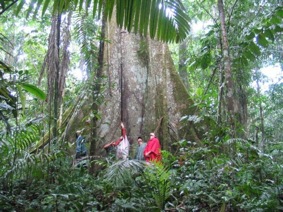
Huaorani territory takes in some 1.7 million acres, but the presence of western life can be felt even here. The missionaries, the loggers and the oil companies have all had negative impacts on this isolated, but culturally significant people and the health and diversity of its tropical environment.
Faced with the destruction of their surroundings and the possible disappearance of their way of life, the Huaorani have chosen to resist. By inviting small numbers of people to share their world for short periods they intend to keep their culture alive. They have opted for sustainable tourism. This is Huaorani Ecolodge.
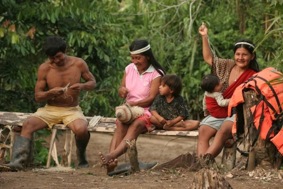
"At the Huaorani Ecolodge, I got a good sense of life in the Amazon. While the comfortable Huaorani-style cabins provided unexpected indulgence in the rainforest, I was able to experience many aspects of Huaorani culture and lifestyle. From walking in the forest searching for peccaries and learning to use a blowgun, to identifying edible fruits hanging off the trunks of forest trees, traveling up and down rivers in a dugout canoe poled by native guides, eating yucca and palm fruits, and enjoying the nightly serenades of frogs and cicadas, I learned both the art and the science of the jungle."- Abigail Rome, USA
The Via Auca is a potent reminder of the presence the oil industry in the Amazon and why sustainable responses have become a necessity if the Huaorani are to survive.
The fight to protect their culture and environment first came to the fore in the mid nineteen nineties. Moi Enomenga of the Quehueri’ono community was featured by the New Yorker magazine and was the principle character of Joe Kane’s book ‘Savages’ (1995) ; an NBC television documentary later told of his struggle to protect his people’s land from oil companies. Moi’s experiences gave him a new perspective. He came to believe that ecotourism could provide a means by which his people might receive an income while maintaining the integrity of their culture and conserving their rainforest territory.
The Ecolodge is one of the outcomes of Moi’s vision. The project to build and run the lodge was developed by the Ecotourism Association of Quehueri’ono - representing five communities on the upper Shiripuno River - and a well know pioneer ecotourism operator based in Quito.
The fundamental requirement was that this Lodge be different. Low impact and local participation were given priority. As part of the planning process other tourist lodges were analyzed for common faults and for ideas on how Huaorani Ecolodge could improve on the experience of the standard lodge while also reducing impacts.
Wood for the construction of the Lodge came from trees chosen by the Huaorani together with a forest engineer, while the location was determined based on its distance from Quehueri’ono. Huaorani community members were involved in the Lodge’s construction and form the majority of the employees ; there are also plans to create complementary low impact small businesses to increase local employment.
Produce is purchased locally. Buildings are lit via solar panels which also power the shortwave radio, refrigerator and water pump. Biodegradable products are used in housekeeping services and bathrooms, and a bio-filter renders all waste products either recyclable or harmless before being discharged into the river. A constant effort is made to improve performance and minimise impacts.
Contact
Jascivan Carvalho
Av. Republica E7-320 y Almagro.
Edificio Taurus Depto 1A
Tél. : (5932) 2234-594/2225907
Fax : (5932) 2560756
Courriel : manager@tropiceco.com
Internet : www.tropiceco.com
Langue : anglais, espagnol
Andrea Fierro
Tropic Journeys in Nature
TLF (593 2) 2234594 / 2225907 FAX (593 2) 2520824
USA Phone 703 879 1575
Skype : tropic.jouneys.in.nature
La Niña #327 entre Reina Victoria y Diego de Almagro
Quito - Ecuador
Email : sales2@tropiceco.com
HUAORANI LODGE
La Niña e7-46 y Reina Victoria (second floor).
Quito - Ecuador Telephones :
Tel : (593 2) 22 34 594 | 22 25 907 | US and Canada : 703 879 1575
Fax : (593 2) 25 60 756
Internet : http://www.huaorani.com/secciones/ecolodge.html

Informations culturelles
The Huaorani in the Ecuadorian headwaters of the Amazon comprise about 2,000 people who are living in up to 24 temporary settlements in an area of almost 20,000 sq. km, completely covered by rain forest. The identity of the Huaorani is characterised by their self-sufficient life off and in the forest whose biodiversity is one of the abundant in the world. The Huaorani are practising a sustainable economy, i.e. the natural resources are not over-exerted. As hunters and gatherers they are semi-nomads. They normally live in their small settlements - surrounded by vegetable gardens in which they grow manioc, maize, peanuts, sweet potatoes, chilli, and fruit. After ten years normally they move on.
Their respective living quarters consist of decentralised subsettlements which are situated at a distance of a two days walk from each other. To the Huaorani this is a kind of refuge which they use in case of danger or when their resource basis is diminishing. The egalitarian social system is both a prerequisite for and a consequence of this type of economy. It does not know a permanent "above" and "below" nor does it know discrimination against women. What it does know are the duties/obligations of the individual for the livelihood and survival of the whole community. Leadership is assumed only in certain situations and for a short period. Once the prevailing problem is solved, leadership is relinquished. In order to secure the survival of the community there is, apart from monogamy, also polygyny and polyandry - in case the gender-ratio is not well-balanced.
Since 1990 the Huaorani territory (i.e. the 6,100 sq. km) has the legal status of a "homeland", a "reserva", which gives the Huaorani a guarantee to maintain their way of life. But since the use of the subsurface is reserved to the state, the Huaorani have no say with regard to the exploitation of oil. In fact, the law also stipulates that any opposition towards oil exploitation is sanctioned with the loss of the homeland status. With the assistance of local lawyers, local and international non-government organisations the Huaorani are trying to pinpoint the contradiction - oil exploitation is just not possible without massive surface interventions - and to force the oil companies to repair the damage as well as to obstruct new prospecting and drilling of boreholes.
Séjour recommandé
Consulter le site : www.tropiceco.com/huao-tours-2005
Titre : Les sources de l’Amazone avec les Huaorani
Durée : 6 jours
Dates : une fois par mois
Prix : US$650
Inclus : tous les repas, les activités, groupe de 4 à 8, guide local, guide naturaliste bilingue, équipement de camping, droit d’entrée dans la communauté et inscription à l’OANAHE
Exclus : transport de Quito - Shell – Quehueri’ono –Coca – Quito. Compter US$200 par personne ; Hébergement à Quito ; tranferts aéroports et pourboires.
Taille des groupes : 8 au maximum
Hébergement : camping. Confort limité. Immersion dans la nature.
Saisons : toute l’année
Activités : randonnée en forêt ; Découverte de la relation spirituelle des Huaorani avec leur environnement ; Visite des artisans d’art .