


Text and photos : Abi Rome et Kyra Cruz
The Bribri and Cabecar Indians ventured into tourism in the Kekoldi Indigenous Reserve in the mid-1990s when they invited visitors to see and support their iguana breeding center, created to repopulate the forest with a historically and culturally significant species brought to near-local extinction. Iguana meat and eggs have traditionally been a preferred source of protein for Costa Ricans of all sorts, but were also favored by the indigenous for medicinal purposes as well as for handicrafts. By educating visitors about the cultural importance of the iguana, the Bribri of Keköldi’s territory are able to generate income to support the project and themselves, as well as to provide a venue for indigenous craftspeople from other communities to sell their baskets, carved coconut bawls, among other handicrafts.
Luis Angel Chaves, one of the main tourism activists, describes the impacts of tourists like this : “Each visitor [to our iguana farm] contributes so that others may also come and see the iguanas. Without visitors, it would be impossible, because we always need resources and materials to be able to do our work. We have no interest in making a profit. We do this for love, because we love the species. They are part of our history and our culture, which maintain from the time before we knew all that we know now.”
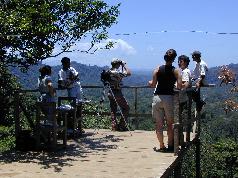
More recently, the Keköldi Wak Kak Koneneke Association has developed additional tourist attractions. In 2002, they built a bird observation tower in their 2500 hectare forest reserve, and they invite travellers to visit to observe annual bird migrations. They also have a lodge for scientists, students and intrepid travellers deep in the forest. This is a rustic lodge, with great views to the forest and the South Caribbean Coast. They offer 6 quad rooms with shared bathrooms. They offer walking tours with interpretation about local ecology, medicinal plants, indigenous culture and traditions.
The Keköldi Wak Kak Koneke members enjoy having the opportunity to explain their lifestyles to visitors, and to allow foreigners to experience and understand indigenous culture. They are proud of their heritage and want others to know that they exist and flourish in Costa Rica, a country thought to be nearly bereft of indigenous blood. Their business is built upon age-old values for forest conservation. As Chaves says, “We work to conserve the forest because if we don’t it’s like losing our right hand. I always say that when the last tree falls, the last Indian will die.”
The indigenous association : Keköldi Wak Ka Koneke
Keköldi Wak Ka Koneke (Kekoldi´s keepers) indigenous association was established in 1994, to protect the forest, promote improvements in the quality of life of the reserve’s inhabitants, defend the land and promote sustainable development. Currently the association has 25 affiliates of the Bribri and Cabécar ethnic groups
Location
San José- Limón-Puerto Viejo route. From Puerto Viejo´s crossroad, drive 800 m. south and then turn right at El Cruce minimarket. 400 m. further is the entrance to Kekoldi community.
By bus : Bus San José-Puerto Viejo from Los Caribeños bus station, at Central Street - 11th Avenue (Transportes Mepe Tel. 257 81 29).
Private transport : Ask ACTUAR for competitive prices.
Map : can you locate the village or community on a map ?
Contact
Name of the person to contact : Kyra Cruz Meyer
Adresse : P.O. Box : 719-1260, Escazú, Costa Rica
Telephone : (506)362-9188
Fax : (506)228-5695
E-mail : actuar@racsa.co.cr
Web site : www.actuarcostarica.com
Other web sites : http://www.eco-index.org/ong/kekoldi-cr-eng.html
Other tour operators in charge of the booking/marketing : Red
Talamanca Ecotourism Network. redtalamanca@corredortalamanca.org
Cultural & background information about the community
The Real Costa Rica, Your community-based Tourism Guide
One of the Keköldi Wak Kak Koneke’s association main objective is to regain the land held by persons or groups that do not belong to their indigenous group. They want to secure the land for future generations to live without destroying the primary forest and to protect it for future generations. The people of the Keköldi Territory partake in the very unique practice of iguana farming. Iguanas are very important to the forest, so due to over-hunting, the Kekoldi tribe has devised a very efficient way to replenish the iguana population. The farm has been operating for 11 years and has about 2,000 iguanas and 2,000,000 eggs. The iguanas stay on the farm until five years of age at which time they are then released into the wild.
For thousands of years the Bribri People have lived in harmony with nature. The Bribri are located in the mountains and low-lying Caribbean coastal areas of southern Costa Rica and northern Panama on the Talamanca reservation. Approximately 5200 Bribri people have maintained an indigenous culture that’s different from the rest of the country. The Bribri were the original inhabitants of Talamanca.
Agriculture is the main activity of the Bribri. They have roughly 120 wild and domestic crops used for food, building materials, medicine, and commercial trading. The Bribri are extremely isolated, and consequently, they have developed an extensive bartering system. Mostly the Bribri women participate in the trading of goods with neighbors. In addition to a bartering system, the Bribri isolation has caused them to have poor education and healthcare. They also have the lowest income per capita in the country ; however, this isolation has made the Bribri a relatively self-sufficient society where there are enough crops grown and livestock raised to sustain them. The Bribri have their own language. They have a rich culture that has been molded over thousands of years and remained relatively untouched by western civilization.
Range of activities and services offered
Target : families, groups, individuals
Recommended seasons : August-November to view the Raptor’s Migration
Types of tours : daily trips, accommodation (building stage)
Accommodation :
6 quad rooms with shared bathrooms. 24 people capacity
Other services :
- Walking and cultural tours
- Handicrafts
- Traditional indigenous meals
A recommended stay (if they have different products)
Please, select one recommended tour or the most representative package and describe it.
Full Day tour : Keköldi Iro Soum
Migrating birds (in Bribri language)
From Puerto Viejo (10 minutes) or Cahuita (20 minutes)
Departure time : 7.00 to 7.30 am Duration : 8 hours approx.
Minimum : 2 passengers
For the most adventurous visitors, we propose this one day tour where we will have the chance to observe the great biodiversity of the Talamanca Mountains.
At the beginning of the trail, our local guide will tell us about the Bribri Indigenous Territory and about the research project for the reproduction of the iguana verde (Iguana Iguana), providing us information about the species reproduction process. Later, he will take us through a secondary tropical forest, where we will observe different flora species, mainly palm trees, cocoa and fast growing trees as the Javillo and Jovo.
We will slowly climb into the mountains’ forest while observing trees of great size and precious wood such as the Pilon, Almendro de Montana, Níspero and Ceibo usually present in the primary tropical forest. The observation of Congo and white faced monkeys, iguanas, ants and spiders is also possible.
The guide will then take us to the highest point, approximately 220 m. above sea level, where a tower was built especially to observe the rapacious birds’ migration which takes place just twice a year : from September to November when they fly from North to South America searching for food, and from February to March when they fly back to North America to reproduce. In one day, it was possible to count over 60000 birds. From this observation point we will also discover the outstanding scenery of the Talamanca mountains, Panama and the coastal zone with a beautiful view of Puerto Viejo, Puerto Limon and Uvita island.
After enjoying a typical local lunch, we will then walk down towards the reserve’s main entrance where this great experience will come to an end and we will be invited to shop for local handicrafts made by these communities.
What to bring ?
Comfortable walking shoes, insect repellent, camera, binoculars, long pants.
Includes : snack, local guide
Difficulty level : High
Name of the tour : Keköldi Iro Soum, Migrating birds (in Bribri language)
Length of the trip : one day tour
Departure dates : departs every day
Seasons or months to visit the place : August-November
Total cost :
_ Without transportation from Cahuita or Puerto Viejo : $17.00
_ With transportation from Cahuita or Puerto Viejo : $24.00
Included : snack, local guide
Excluded : lunch
Type of services (guiding, interpretation, meals)
Group sizes allowed : up to 20 pax
Age, fitness requirements, physical conditions, special skills needed : good physical condition
Type of weather : warm humid weather
Specific recommendations (optimal clothing, gear required, restrictions, encounters, opportunities) : Comfortable walking shoes, insect repellent, camera, binoculars, long pants.