


Text : Stéphanie Thullen, Photos : REST
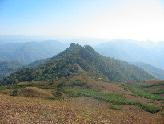
Ban Huay Hee is a small Karen community located in the mountains of Mae Hong Son province in Thailand. It was in 1997 that the villagers became interested in community-based tourism (CBT) as a way to supplement their income, gain some benefits from tourism, and address some environmental problems they had been experiencing as a result of unregulated tourism through the area. In addition, CBT is harnessed as a communication bridge to educate visitors about traditional Karen farming practices and the intimate relationship between Karen people and nature
The village approached a local NGO, Project for Recovery of Life and Culture, with whom they already had a long relationship, and its partner, Bangkok-based Responsible Ecological Social Tours Project, to help them develop a CBT initiative in the community.
Every single household in Ban Huay Hee is involved in one way or another with the CBT project. They developed a rotation system for homestays and local guides so that every household shares the responsibilities and receives income from tourism, not just one or two families. Twenty percent of the income earned by homestay hosts and guides goes into a village fund. This fund is used for activities related to the project, such as forest conservation, orchid growing, buying equipment for hosting tourists, and to finance travelling and education costs related to the project.
The women of Huay Hee participate mostly by cooking meals for tourists and by demonstrating and selling traditional Karen weaving. They have expressed that through tourism they now have the opportunity to spend more time weaving and earn money from items sold to the tourists. There are even a couple of women who act as local guides, explaining to the tourists about the way of life of the village.
CBT has not replaced but complemented the village’s main source of subsistence, agriculture. All villagers would like more tourists to come, but not so many that it would disrupt their way of life—their priority is to work in the fields and grow rice and vegetables, not tourism. Villagers also incorporate CBT activities into their everyday life. While guiding tourists to Doi Pui, a villager might take along some of the orchids growing in his nursery and replant them on the way up the mountain. Or, if the tourists are taken to the rice fields, where the Karen show them their traditional agricultural practices, they will also take advantage of the time there and check their crops for weeds or pests. Tourists are also encouraged to participate in orchid replanting and to work in the rice fields.
The evenings are reserved for cultural exchange between the tourists and the villagers, one of the most important activities in Huay Hee. Usually the headman begins by talking about the CBT project, then tourists introduce themselves, say something about their countries, why they came to visit Huay Hee, and any other questions that the tourists would like to find out about the villagers and their way of life. The villagers also have the opportunity to ask questions to the tourists, including “what is the weather like in your country,” “are the any poor people in your country,” etc. There is also a musical performance by the choir, singing some traditional and Christian songs.
Through the CBT project, the villagers of Huay Hee have found a way to supplement their income and improving their standard of living on their own terms. They also have gained the self-confidence to share their culture and vast knowledge about their surrounding area and demonstrate to visitors how they protect their forest and at the same time continue to live their lives in accordance to their traditions and in harmony with the environment. The success of the CBT project has since sparked the interest and initiative of eleven neighbouring communities, who subsequently received training and support from PRLC and REST to develop their own CBT products and services and participate in a growing Mae Hong Son CBT Network.
Location
Ban Huay Hee is located in Mae Hong Son province, a mountainous province in the northwest of Thailand bordering Burma/Myanmar, about 900 km from Bangkok.
From Bangkok you can fly or take a train to Chiang Mai, from there it’s an 8 hour bus ride or 30 minute flight to Mae Hong Son town. From Mae Hong Son it’s another 30 km drive into the mountains to Ban Huay Hee, which can only be accessed with a tour operator
Contact
In Bangkok
Responsible Ecological Social Tours (REST) Project
Potjana Suansri (Project Manager)
109/79 Mooban Yucharoen Pattana, Ladprao Road, Soi 18
Ladyao, Chatuchak, Bangkok 10900, Thailand
Tel. : +66-2-938 7007
Fax : +66-2-938 5275
Email : rest@asiaaccess.net.th
Internet : www.rest.or.th/about/default.shtml
www.cbt-i.org
In Mae Hong Son :
PRLC (Project for Recovery of Life and Culture)
53 Moo 8
Tambon Pan Moo
Amphur Muang
Mae Hong Son 58000
Tel : +66 (0) 53 613 462-3
Cultural Information
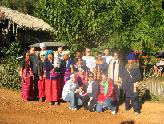
Ban Huay Hee was originally settled more than 170 years ago, and nowadays there is a population of about 200 people. The people are Sgaw Karen, which is part of the Karen ethnic group, the largest highland ethnic group in Thailand (for more information see
www.infomekong.com Or
karen_secondary_sgaw.htm.
There is one primary school with two teachers, a small shop and a church. All households except for one are Christian, although there are no conflicts between them and the animist family. There is no electricity in the village, but a solar-cell station powers the satellite telephone and the two television sets.
The main source of subsistence for the community is upland rice farming. Their deep knowledge about forests and agricultural ecology allows them to sustain the fertility of the soil. This community uses a cyclical land rotation system for growing rice, corn and other vegetables, all in the same field. In this system a plot of land is cleared of trees, but the roots and at least one meter of the base of the tree are spared. This ensures that the trees do not die, allowing the forest to regrow and regenerate the soil when it is left fallow. Each plot of land is used for one year and then re-used every 6 to 10 years. Some of the community’s land is located within Mae Surin National Park, and the villagers have been blamed in the past for deforestation and the degradation of watersheds. The Forestry Department at one time even threatened them with relocation if they did not change their traditional agricultural practices.
The villagers themselves will share all aspects of their culture with the tourists. For example, when a tourist visits he or she will learn directly from the villagers that Huay Hee is a Christian village and that they do not drink alcohol or smoke. When tourists learn from the villagers themselves, they tend to respect their customs and traditions even more. REST provides a code of conduct to its clients, and the community has posted its code of conduct for tourists and hosts in the community house of the village.
Range of activities and services offered
Target : families, small groups (up to 10 people) or individuals
Recommended seasons : Any time of the year, but best during the cold and hot seasons, October to April.
Types of tours : 2- or 3-day tours. Trips to Ban Huay Hee can be combined with visits to neighbouring communities, trekking and birdwatching.
Tours include homestays with local families, meals, local guides in the village and for trekking, cultural show and cross-cultural exchange. Visitors can learn about Karen agricultural practices and way of life, including weaving, basket making and blacksmithing. Hikes to the top of Doi Pui Mountain, orchid nursery and agricultural fields.
Recommended Tour
Name of the tour : Touch Karen’s Life and Nature of Doi Pui
Length of the trip : 3 days 2 nights
Departure dates : On request
Seasons or months to visit the place : Best October to March
Total cost : 4-6 people US$120
Included : transportation (4WD), English speaking guide, Meals & Accommodation, Campsite Entrance Fee, donation, Insurance
Excluded : Alcoholic and soft drinks, souvenirs and other personal expenses
Type of accommodation : Homestay and camping
Type of services : guided walks, cultural exchange
Booking for this trip : Contact REST (see above)
Group sizes allowed : 1-10 pax
Age, fitness requirements, physical conditions, special skills needed : No special requirements needed, except for trekking you need to be in reasonably fit condition.
Type of weather : October – February : warm days and cold nights, especially in December and January, not much rain. March-May : hot days and cooler nights, no rain. June-September : Rainy season, with warm days and cool nights.
Specific recommendations : (optimal clothing, gear required, restrictions, encounters, opportunities..). Bring warm clothes and a sleeping bag if visiting during the cold season, as nights can be quite cold (around 8°C). At other times a fleece or pullover is sufficient for the cooler nights. Walking boots, flashlight/torch (there is no electricity).
“Community Based Tourism Handbook’ presents a well-organized, comprehensive introduction to the process for developing community based tourism projects. The book represents the work of a group of dedicated practitioners in community tourism projects around Thailand.” International Ecotourism Monthly Year 5. Issue 54, Nov, 2003