


Text : Paul Eshoo
Photos : Tara Gujadhur, Souksan Pakzy, Jan Burrows, Nam Ha project.
We left the office later than expected, rushing to collect our materials for our four-day mission. Our mission : to create awareness in target villages about the good and the bad of tourism and to build an understanding on how villagers can both minimize the impacts from tourism while benefiting from it in a sustainable and equitable manner. Our work was part of the “Pro-Poor Tourism Component” of the Mekong Tourism Development Project (MTDP), implemented by the Lao Government’s National Tourism Administration (LNTA) and funded by a loan to the Lao Government by the Asian Development Bank (ADB).
We were to visit four ethnic villages (Hmong, Lanten, Khmu, Sida) located on Pu Sam Yord (Three Peaks Mountain), a massive mountain visible from Luang Namtha town. This trek was selected by our project from more than fifteen other potential tourism sites in the province for its rich cultural diversity (four ethnic groups), natural beauty (thick jungle, panoramic views, varying terrain) and income needs/remoteness of villages.
We began our walk in the morning about 20km from the main town. The route was grand with thick green forests, crisscrossed with trickling streams and bountiful with forest products of all shapes, sizes, colours, tastes and uses. Our Lanten guide casually pointed out different plants and fruits along the way, sharing with us what seemed to him to be common knowledge but to me an absolutely new and unexpected experience.
After perhaps two hours we emerged from the thick jungle onto the ridge of Sam Yord Mountain to take in the exquisite view of the surrounding mountains, resting freely from the from the concrete shackles of “development.” We continued weaving uphill through the forest and occasional upland rice fields, marvelling at our natural surroundings.
After more than five hours of strenuous uphill ascents, we finally made it…or did we ? This was New Sam Yord Village (Sam Yord Mai), a Hmong village that had moved to (what they considered) a lower location closer to the road from their old village, Sam Yord Kao—our intended destination. The villagers were so excited that we had come. They had never seen any tourists in their village and rarely had any other visitors at that.
We moved on and after a long day hiking, we finally arrived in the village, Old Sam Yord. We made it, and what a distance we’d covered in just one day. The village chief was all smiles and humoured by the fact that we had walked such a long distance to his village. Without hesitation, he cooked us a warm, meal of highland plain rice and engaged us in good conversation. Finally, we settled into the beds that the villagers graciously made for us and savoured the comfort of this remote Hmong village. The best sleep comes after a long journey.
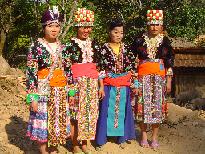
The following morning the tourism awareness meeting was well attended by the curious villagers, gleaming in traditional Hmong outfits for the important occasion. After a presentation about who tourists are and why they come to Lao PDR, a discussion began about how to minimize negative tourism impacts in the village. The villagers began opening up and provided us with some important Do’s and Don’ts.
“They should never touch the altar inside the house,” a shaman explained. “You should not enter a house that has a branch placed in front of the doorway without asking,” an elder warned. “Don’t give candy to children,” a mother added. The list grew and grew as the villagers became more enthusiastic and open in sharing their cultural taboos.
It was then that one man stood up in the back and quietly pleaded : “We welcome all tourists. But are you sure that they will want to come such a long distance by foot ?”
If you think that we answered “yes” to this man’s astute question, then we invite you to come to Laos, put on your walking shoes and show by example that the journey to Sam Yord—and dozens of other remote villages in Laos—is well worth the effort.
Location :
In Laos we work in four provinces (highlighted in green on the map) : Luang Namtha, Luang Prabang, Khammouane, Champassak. A breakdown of each site and respective villages by province is given below :
Luang Namtha Province : We work in three areas and 11 villages :
1.Pu Sam Yord Trek : (villages : Kok Mee, Sam Yord, Nam Talan, Nam Kone),
2.Nam Ha Forest Camp (villages : Don Xai, Nammat Mai)
3.Akha Trail (villages : Nam Lo, Pouyai, Nam O, Ta Louang, Thong Lat).
Luang Prabang : We work in three areas and seven villages :
4.Chomphet 2-day Trek (villages : Houaypong, Pu Luang Tai, Som, Mouang Kha)
5.Muang Ngoi (villages : Ngoi Kao, Kiew Kan, Houa Sen),
6.Kwangsi Waterfall 1-day Walk (villages : Long Lao, Nong Heo, Ta Paen).
Khammouane : We work in three areas and eight villages :
7.Phou Hin Poun Protected Area Trek (villages : Na, Phalem, Pountong, Nakeu, Kon Keo),
8.Buddha Cave area (villages : Nakhan Xang)
9.Kong Lor Cave area (villages : Na Hin, Kong Lor, Natan).
Champassak : We work in the three areas and six villages :
10.Don Daeng Island (villages : Hua Don Daeng)
11.Pu Khong Mountain (villages : Mai Singsamphan, Don Kho)
12.Xe Pian Protected Area (villages : Palai Bok, Ta Ong, Kiat Ngong).
Access :
Guide service units and tour companies who operate tours to the sites work out of provincial or district capital towns. What you need to do then in order to get to the site is to travel to the provincial or district town from you can start the tour. Each of the four provinces offers various alternative routes, which are outlined below :
Contact

Mr. Sounh Manivong
Director of the LNTA-ADB Mekong Tourism Development
PO Box 3556, Lanexang Avenue
Vientiane, Lao PDR
Tel. : (+856-(0)21) 212 251
Fax : (+856-(0)21) 217 910
Email : snh_manivong@yahoo.com
Internet : www.ecotourismlaos.com
www.tourismlaos.gov.la
Language : English
Luang Namtha province
Luang Namtha Guide Service ; (+856 086) 211-534 Mr. Bountha
Vieng Phoukha Guide Service ; +856 086) 212-400 ask for Mr. Khammouane
Green Discovery : www.greendiscovery.com ou (+856-(0)86) 211 484
Luang Prabang province
Action Max (Luang Prabang)
Tel : (+856-(0)71) 252 417
Email : actionmaxasie@yahoo.fr
Internet : www.actionmaxasie.com
Lao Youth Travel
Luang Prabang
Tel : (+856-(0)71) 253 340
(+856-(0)21) 240 939 (Vientiane)
Email : youtheco@laotel.com
Internet : www.laoyouthtravel.com
Luang Prabang Tourism Office
Tel : (+856-(0)71) 212 487 (Demander cette personne Vongdavone)
Khammouane Guide Service
(Thakek District)
Tel : (+856-(0)51) 212 512 Office
Tel (+856-(0)20) 232 8217 Mr. Kenta
Na Hin Guide Service (Hin Poun District)
Tel : (+856-(0)20) 575 7439 Ms. Muang Kham
Champassak province
Provincial Tourism Information Office
Tel :(+856-(0)31) 212 021 Mr. Sulichan
Kiat Ngong Village
Tel : (+856-(0)20) 573 1207
Champa Mai Travel :
Tel : (+856-(0)31) 212 932 Ms. Sonesida.
Servies Offered :
Target : Activies are aimed at small groups (2-8) of sensitive travellers looking to get off the beaten track and participate in a unique program that benefits both local people and natural/cultural protected areas.
Recommended seasons : October to May are the best months, as the rainy season from June through September makes travel difficult.
Types of tours provided : We provide trips on-site services that include 1-4 day activities. All of the activities include food in villages, village guides and accommodation in the village.