

Text : Métilde Wendenbaum and Gulmira Ishen
Photos : Jacqueline Ripart and Shepherd’s way trekking
Shepherd’s Way trekking is the story of Gulmira & Ishen, both coming from traditional shepherd’s family, in the region of Issyk-Kul, Kyrgyzstan. In the shepherds’ families, everyone, children included, is used for centuries to take care of the horses, clean them, feed them, live with them.
Gulmira as a child used to go down everyday from the mountains to the school in the valley, 10 km far away. During communist time, arriving at school by horse was badly seen and Gulmira was therefore leaving her horse at the entry of the village.
Gulmira & Ishen met each other while following English courses at the Kyrgyz State University, Bishkek. They got married and decided to come back to their native village Barskoon, at 1600 m. above sea level and worked as English teachers at school. At that time there was a high level of alphabetisation (99%) even among the most remote communities and health care were provided for free.
In 1991, after the collapse of the former Soviet Union, salaries were paid with delay of 5-6 months, products were no more available in shops, there was a big inflation….Not being able to face everyday life difficulties anymore, the couple moved to Bishkek in order to find a better job, better conditions of life.
Ishen participated then to the creation of a governmental tourism agency in Bishkek specialised in horse-riding. But after 2 years in this company and thanks to the advises of a Swiss friend, they both decided to move back once again to their village and carry on horse-riding tourism activities over there. Ishen worked five years more in a mine company in order to get a bit of money and invest it in their new tourism company.
In 1994, the firm ‘Shepherd’ Way trekking’ based in Barskoon village, south of Lake Issyk-Kul, was founded by Ishen, his wife Gulmira and Rash Obolbekovs, brother of Ishen .Rash is the youngest of the family .And in our culture the youngest stay with the old parents, take care of them and inherit the father’s heritage. Now he is in Barskoon (base of our horseback riding trek) with our father .He is responsible for the horses and all organization work in Barskoon. They are the only Kyrgyz agency with own horses devoted exclusively to horseback-trekking.
After 2-3 years, they hired some more people from the village and trained them to receive tourists. They are working now seasonally on 3 villages and 15-20 people among those villages are living from this tourism activity. During the rest of the season, those people are farmers or shepherds.
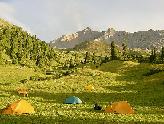
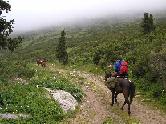
The company provides experienced horses with extremely comfortable Kyrgyz-style saddles whose thick wool padding actually prevents significant soreness to the rider. Along the way, the crew cares for the horses, sets up camp and prepares all meals, thus allowing travellers maximum time to enjoy the soothing and relaxing scenery all around.
Treks are adapted depending on the riding skills and endurance of participants : from very easy treks along wide paths, to difficult treks crossing large rivers, high passes and rides above impressive gorges. All these tours give horseback riders a view of Kyrgyzstan’s nature in its pristine condition. During tours guests will see the nomadic way of life of the Kyrgyz people.
All trips originate in the village of Barskoon, on the south shore of Lake Issyk-Kul.
13 different horseback tours are offered, ranging in duration from 4 to 30 days.
Groups of 2 to 8 riders are most common. Guides can speak English, Kyrgyz and Russian. They are all trained in horse handling, first aid and have mountain emergencies experience.
Accommodation will mostly be in tents (yurts) and local bed and breakfasts.
The company members are highly involved in nature protection activities via among others, the development of seminars on schools on how to protect the nature and for ex. collect and sort out the wastes.
Visitors are also encouraged to buy handicraft products from the community hat, shoes, slippers, small souvenirs, Kyrgyz carpets, bags. Gulmira is on the way to launch a program to help the network of 10 women already existing in their village selling handicrafts to tourists locally, and abroad. They are going to work soon on the quality and the design of items.
Contact
Gulmira, Ishen & Rash Obolbekov
P.O. Box : 2032, Bishkek, 720000
Kyrgyz Republic
Tel : +996-312-29 74 06 OR
+996-312-66 73 71
Mobile : + 996-502-51 83 15
Email : shepherd@elcat.kg
Internet : http://www.kyrgyztrek.com
Other tour operaters
In France : Cheval d’Aventure, Caval’Rando, Nomade Aventure, Tamera Voyages d’Aventures.
In Switzerland : Voyages APN. En Grande Bretagne ; The Adventure Company,
Cultural Information
Kyrgyzstan used to have different tribes, each one being controlled by a king. Each representative of those tribes used to sit in the parliament (called the “group of white beards”). The system includes still nowadays non-officially a group of such wise men.
Nomads in the past use to live from milk and goat meat, from exchanges of agricultural goods with China and Uzbekistan. The richness of each region was depending on the diplomatic ability of the head of the tribe (e.g. the head of tribe in Issyk-Kul set up important peace agreement with Russia and China and the population accessed to tools, seeds, new horses…). Nomads used to have 15-20 years ago very hard conditions of life.
Many of the young people are now studying abroad in order to get more chance to get a job at their return.
Kyrgyz people are spiritual people giving importance to the animals, the water, the silence, the wood, the bread…close from the nature and without any willing of conquest of territory.
Respect to women is one of the bases of the society (an expression speaks about the duty of a son to “pay back its mother milk”). Links in families have always been extremely important. Usually the youngest son stays with and takes care after old parents. Women and men are living side by side and a lot of women accessed to high political level.
After the collapse of the former Soviet Union, women were the first to find new solution to live as they husband were mainly desperate having been loosing all activities.
Recommended Tours :
Title : Jyluu-Suu trek (High Mountain Trekking on Horseback)
Duration : 8 Days Trek
Type of Activity : horse-riding
Level of difficulty : Intermediate
Dates : each week Depending on airlines chosen -Turkish Airlines (Arrival/Departure : Wednesday, Friday, Sunday), British Airways (Arrival/Departure : Tuesday, Friday, Sunday), Lufthansa, Kyrgyzair form Hannover, Germany, Aeroflot through Moscow (everyday).
Seasons : June-September
Price for the trek : Prices are between 60 to 90 Euros per person, per day. Prices vary according to the region of the trek, the difficulty and the number of participants.
Prices include : accommodation in house or yurta on arrival & departure in Barskoon village, horses, guides, tents, 3 meals a day, cooking equipment, first aid kit.
Accommodation : in house and yurta in Barskoon village
Additional services : accommodation in Bishkek & Karakol, transportation, guide and translator services
Reservation : direct booking (see email above) or via partner companies
Size of the group : min. 2 persons and max. 8 persons
Conditions required : from 6 to 70 years old (we have experience to take 9 month child before)
Climate Conditions : From mid-April to mid-October : in April, May : +2° C to +20° C, June-August : in Barskoon village +20° C to +28 ° C, in the mountains +10-15 ° C daytime, -3-5 ° C nighttime. September-October : in Barskoon village +10 ° C to +15° C, nights can be very cold (-3° C), in the mountains +3° C to +8° C (nights are very cold). In the mountains sometimes it could be very cold even to -11° C. In Bishkek area the weather is very different, during summer it can reach +40° C.
You need to bring : Down jacket and warm sweater, warm sleeping bag, rain gears, silk blanket for inside sleeping bag, 2-3 pairs of warm socks, trekking waterproof boots, gloves, sunglasses, suncream, flashlight, personal medicine, metal water bottle (0,75 litters), Term-A-Rest mats, riding chaps, micro pure (or any other water disinfections).