


Text : Anna Spenceley, Photos : Sylvie Blangy
The Makuleke people were forcibly removed from a 24,000 ha area that they inhabited in the north of Kruger National Park in 1969 by the state. They were compensated for their relocation in 1998, with the restitution of their land and the creation of a contractual park. A 25-year agreement was forged between the Makuleke and SANParks, the National Park authority, to return the ownership and title of the land to the people, although the title specifies that the land may only be used for wildlife conservation. The contract that governs the incorporation of the Makuleke land in KNP enables them to make sustainable use of specified natural resources. They have the option to construct six small camps with a cumulative occupancy of 224 beds, and the location of these has yet to be decided. The area has been identified by some environmentalists as Kruger’s best birding area, because many of the central African species find their way here. Elephant, nyala, lion, leopard and bushbuck are among the most common wildlife species encountered regularly in the densely wooded region. The area of land in KNP owned by the Makuleke Common Property Association (CPA) is called the Pafuri Triangle. The land stretches from the Limpopo to the Luvhuvhu River, and therefore at the centre of the GLTFCA.
Trophy hunting is a controversial issue but is important in the Makuleke case because it has been able to delivers quick revenues to local people, during the period while lodges and camps are being built. The trophy-hunting project affords the Makulekes a tangible material benefit that is enjoyed by the entire community, in that the “venison” acquired from a hunt is equally distributed to every household. However, some Makuleke are of the opinion that these community wide benefits are not substantial enough. The CPA wants to phase out hunting as the lodges and camps begin to bring tourists and revenue to their area.
Location
The Makuleke village is located on a site overlooking the Soutpansberg Mountains, about 12 km from the Punda Maria gate into Kruger. Situated inside the Makuleke’s contractual national park in the northernmost part of Kruger National Park, The Outpost rests high on a hill overlooking the flood plains of the Limpopo and Luvuvhu rivers. This region, formerly known as the Pafuri region, is in the northernmost part of Kruger National Park and is bordered to the north by the Limpopo and Zimbabwe and to the East by Crooks Corner and Zimbabwe
Contact
For the Cultural Centre and Village
The Makuleke’s Communal Property Association (CPA)
Dennis Skhalela
Email : makuleke@mInternet.co.za
Tel. : +27 (0)15 853 1286 / +27 (0)15 853 0063
For the lodges
Pafuri Camp
Wilderness Safaris (Pty) Ltd
Leigh Scullard
P.O. Box 5219, Rivonia, 2128, South Africa
3 Autumn Street, Rivonia, South Africa
Tel. : + 27 11 257 5207 (direct)
Email : leighsc@wilderness.co.za
Internet : www.wilderness-safaris.com or www.pafuri.com
The Outpost
Mix (Marianne Gray / Peter Aucamp)
10, Bompas Road, Dunkeld West, Johannesburg
P.O. Box 786064, Sandton 2146, Afrique du Sud
Tel. : +27 (11) 341-0282
Fax : +27 (11) 341-0281
Email : reservations@mix.co.za or marianne@mix.co.za
Internet : www.theoutpost.co.za
Language : English
Cultural Information
The present-day Makuleke community consists of three villages outside the park, with a total population of approximately 10,000. Most of the men work in Johannesburg, while some of the women work as domestic workers in nearby towns (although this activity is limited by their household responsibilities). Some families are very poor and have no cash income, and an average family of 7 to 10 people survives on the R620 ( US$60) monthly pension of an elder in the family. The area has four primary schools and one high school. Transport is only available through taxis that do not service all the villages due to poor roads, and only a few people have cars (Ford Foundation, 2002).
For an overview of the Makuleke’s experiences, read the Makuleke section of Anna Spenceley’s paper ‘Tourism investment in the Great Limpopo Transfrontier Conservation Area’ which is available from the Transboundary Protected Areas Research Initiative at
www.wits.ac.za/tbpardigitalhistory/Indaba%202005.htm
Range of activities and services offered : Makuleke CPA
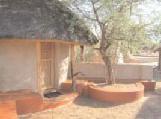
The Makuleke CPA offers rustic B&B experience within the community, with meals and traditional entertainment. The operation has just started, and therefore they request that visitors ask for the type of experience they wish to have, and they can arrange suitable activities.
Target : Low budget visitors who want a cultural experience.
Recommended seasons : Winters the days are sunny and warm, while in summer temperatures are very hot, and there are thunderstorms.
Rates : R150 per person for accommodation, and R75 p/p for breakfast, lunch and dinner.
Type of accommodation : Rondavels in the Makuleke community
Type of services : Available on request, but include cultural tours and activities.
Group sizes : There are 6 rondavels which each have 2 beds (12 beds in total)
Type of weather : Winters the days are sunny and warm (May-Sept), while in summer temperatures are very hot, and there are thunderstorms (Nov-April).
Range of activities and services offered : The Outpost
Types of tours : Guests are offered a choice of a long or short game drive in the morning and again in the mid afternoon. Game drives will be conducted by qualified and experienced guides in open-air four wheel drive vehicles. Guests who would like to experience the bush on foot may do so after breakfast or as an alternative to a game drive in the early mornings and late afternoons. Walks will be conducted in parts of the region not accessible to vehicles including the spectacular Lanner Gorge.The history of the Makuleke people is best explored by a visit to the Makuleke Village in the capable hands of a Makuleke guide. The region’s rich historical and cultural heritage, can be explored by guided visits to Crooks Corner and the Thulamela archeological site overlooking the Luvuvhu River. Articles dating from 1460 to 1640 have been found tying them to the last phase of the Zimbabwe culture. In the late 19th century, the historic Ivory Route passed along the Luvuvhu River to Crooks corner at the confluence of the Limpopo and Luvuvhu rivers and the border of Mozambique, Zimbabwe and South Africa.
Target : Luxury lodge
Recommended seasons : as above
Rates : (valid until 30 Sept 2006) R2300 per person, per night, sharing. A single supplement of R300 per person will only be levied from the third single onward in the same reservation. The rate includes all activities, meals and drinks but excludes entrance fees to Kruger National Park
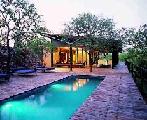
Type of accommodation : Guests are accommodated in en-suite living spaces that are placed alongside a walkway on the side of a hill overlooking the Luvuvhu River. The Spaces are of contemporary design with retractable canvas screens and frontage offering a 180-degree views of the Luvuvhu River Valley. The open feel of the rooms is extended into the full bathroom with concrete bath and open shower and a view extending as far as Mozambique
Type of services : The Outpost offers game drives, birding, hiking and visits to the Makuleke village, and trips to the historical site of Thulamela.
Group sizes allowed : 24 beds in 12 en-suite rooms.
Specific recommendations : The Outpost is located in a malarial area, and visitors should contact their pharmacist / Travel Advisory Clinic for advice regarding recommended prophylaxis. Light cotton tops and trousers or shorts in khaki, beige or white or light cotton, long sleeved clothing is appropriate for game drives and walks.
Makuleke Communal Property Association Organization
Makuleke’s Communal Property Association (CPA) holds the contract with their private sector partner, Matswani Safaris, who developed The Outpost. An initial fee was paid to the Makulekes on signing of a contract, and Outpost Lodge has provided a bond to guarantee its performance for the duration of the agreement (THETA, undated). In addition, the Outpost pays the CPA 8% gross earnings generated by the business, a traversing fee for game drives, and 2% of gross earnings into a social development fund earmarked for the education of Makuleke youth (Ford Foundation, 2002). They also pay a monthly traversing fee for every vehicle based in the Makuleke region (THETA, Undated).