


Text and Photos : Anna Spenceley

The Wild Coast is one of the most beautiful and underdeveloped regions of South Africa. Rolling hills, extensive grasslands, pockets of coastal forest, rich rivers and estuaries, and pristine sandy beaches. Although very poor, the Xhosa people of this region are friendly and welcoming, and the Amadiba people in particular offer generous hospitality to tourists through Amadiba Adventures.
Amadiba Adventures was started in 1997 in consultation with the Amadiba people and local government structures, and with the support of Ntsika Enterprise Promotions Agency. The aim was to introduce a particular type of tourist to the region – someone who was genuinely interested in meeting the people and learning from them, in coming to understand the environment and history of the region, and in leaving spiritually and culturally enriched.
People from the Amadiba community work on the trail, and are paid a rate calculated on a per day, per tourist basis. Along the length of the trail, horses used are sourced from different villages and owners are paid in relation to the distance their animals travel. This system that allows payment and use of horses to be spread around the area. One of the things that makes this trail very special is that visitors know that the money they pay is going directly to the people working on the trail, and the people who own the horses. Therefore money paid by visitors stays in the community. Within their trail fee, tourists pay a small daily levy which is placed in a trust fund managed by the Amadiba Coastal Community Development Association (ACCODA). The money is used to cover salaries, but is also intended to fund community development initiatives.
Reports indicate that initially some members of the Amadiba community were resistant to the initiative, as they were concerned about land dispossession in the process of establishing the trail (something which has been common in relation to illegal cottages owned by outsiders). However, through a number of meetings between PondoCROP and the community, confidence was built that their landholding would not be affected. There were also initial concerns that nothing positive would be gained if the community owned the trail, while others thought the idea was unfeasible.
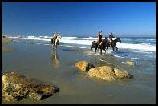
Amadiba Adventures currently offers guided horse and hiking trails along 32 km of one of South Africa’s most scenic and un-developed coastlines : the Wild Coast. The trails are suitable for beginners or more advanced riders, and use horses that are owned by members of the Amadiba community. Visitors can either hike or ride along the trail, which passes along clean sandy beaches, through rural communities, and all of the employees at the camps and along the trails are members of the community, and visitors will also meet the Pondo people they encounter along the way. There are opportunities for canoeing in the stunning Wild Coast’s estuaries and rivers, to swim in clear pools, and refresh yourself under sparkling waterfalls. Visitors can select the type and length of trip most appealing to them, and join the trail for between one and six days. They offer 1-,4- and 6-day trails, either on horseback or as a hike.
Location
Amadiba Adventures offices, and the start of the trails, are based in the Mzamba Craft Village, +/-6km south of Port Edward and opposite the Wild Coast Sun Casino. The closest international airport is Durban International, +/-180km north of Port Edward along the N2. The closest domestic airport is Margate, based +/-28km north of Port Edward. Port Edward offers a range of accommodation options, from backpackers/river lodges/B&B’s and hotels.
Contact
Mzamba Craft Village, Main Road Bizana
P.O. Box 588, Port Edward, 4295
Tel : +27 (0)39 305 6455
Fax : +27 (0)39 305 6538
Language : English or Xhosa
Email : amadiba@euwildcoast.za.org or
communitytourism@euwildcoast.za.org
Internet : www.amadibaadventures.co.za
Cultural Information
For a detailed and overview of the Amadiba community and the trail, read Zolile Ntshona and Edward Lahiff’s paper ‘Community-Based Eco-Tourism on the Wild Coast, South Africa : The Case of the Amadiba Trail’ which is available from the Institute of Development Studies at :
http://www.ids.ac.uk/slsa
Range of activities and services offered
Amadiba Adventures offers horse and hiking trails along the Wild Coast of South Africa. Other activities include canoeing, visiting a local sangoma (traditional healer) and overnight stays in a Xhosa homestead with a Pondo/Xhosa family.
Target : Families, groups, individuals, backpackers and schools
Recommended seasons : The trails are open all the year round. The driest and coolest time of year to visit is between May and September.
Types of tours : Trails are fully catered with tasty food, and prices include accommodation in tented camps, river crossings and canoe trips.
Type of accommodation : Tented camps with hot bucket showers and eco toilets. Bedding, tents and mattresses or beds are provided.
Type of services : Guiding, interpretation, horse riding, hiking, canoeing, visits to Xhosa villages and sangomas (traditional healers). Valuables and additional luggage can be left in the Amadiba Offices, as well as a safe facility for passports/travellers cheques.
Group sizes allowed : Maximum of 12 people at each camp.
Age, fitness requirements, physical conditions, special skills needed : The trail is open to people of all ages and levels of fitness. People who want an active experience can opt for horse or hiking trails – while more relaxed trips are available with the drive-in option. No special skills are needed, and both beginner and advanced riders are welcome.
Type of weather : The climate in the Eastern Cape can be hot and humid in summer, when most rain falls.
Specific recommendations : Riding hats are provided. Space on the trail is at a premium and small bags or packs are most suitable. Saddlebags are provided for horse trails, with 10kg capacity. Things you should bring include : Swimming costume and towel, Hat and Sun Block, Sandals and Trainers, Shorts and T-shirts, Warm clothing (it can get cold at night), Rain Jacket, Torch, Toiletries, Prescribed Medicine and insect repellent
About the trail
One-day Horse Trail : Full days ride, you will need to provide your own lunch, trail takes you along 9km’s of the Wild Coast along beach and grasslands, to a lunch stop over at Phushungwane pools. Trails start at Mzamba River after a short hike, 3.8km’s along the Mzamba Beach.
Four-Day Horse or Hiking Trail : Spend 3 nights and 4 days along the Wild Coast, over nighting in tented safari camps, inclusive of all meals, excluding first days lunch, river crossings, canoe trips, waterfall/shipwreck visits and hikes through Mkambathi Nature Reserve.
Six-Day Horse or Hiking Trail : Spend 5 nights and 6 days along the Wild Coast, all inclusive as in the 4 day trail only get to enjoy 2 extra days of pure relaxation and untouched magic.
Drive in Trails : Choosing to be quite popular for the less adventurous – the trail is accessible by 4x4.
Departure dates : Trails depart on Mondays and Thursdays
Low Season : February May August September October November
High Season : January March April June July December
Contact Amadiba directly for special school rates
Description of the organisation in charge of the community project :
Amadiba Adventures is a community-based tourism initiative. All facilities and services are entirely owned and operated by local people in the form of micro enterprises. Part of the proceeds from the trails is invested in a Community Trust Fund for the improvement of health, education and infrastructure in the area. For the local people, it creates an opportunity to participate in all aspects of tourism, from planning and implementation to operation and management. It presents an alternative to large-scale investor driven development where large resorts monopolise the benefits from the influx of tourists to their region.
The Initiative was started in 1997 in consultation with the Amadiba people and local government structures, and with the support of Ntsika Enterprise Promotions Agency. The view was to introduce a particular type of tourist to the region – someone who was genuinely interested in meeting the people and learning from them, in coming to understand the environment and history of the region, and in leaving spiritually and culturally enriched.