
Text and photos : Serge Ashini Goupil et Fabien Deglise
AVENTURES ASHINI offers an authentic visit of discovery in exceptional surroundings. A vast range of activities centering around the traditional way of life of the Innu (also known as the Montagnais). Discover who they are, their history, their rich culture, and their contemporary way of life.
We offer packages that highlight various aspects of the territory where we have established our camp. According to chosen package, the themes touched upon include the evolution of the area, the animal and plant life, ancient human habitation, as well as the traditional and current way of life of the Innu.
Located 250 kilometers north of Schefferville, in an area around the George River, this traditional Innu camp will allow you to discover an authentic Aboriginal culture. This territory is an important reference point in the history of the Naskapi and the Innu of Québec and Labrador. The Innu named this place “Mushuau-nipi”, the Land without Trees. On different maps, this area is also called Indian House Lake.
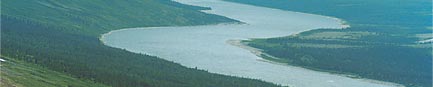
A vast river stretching out across the tundra and enclosing the region of the Mushuau-nipi. Its width reaching five kilometers in some places and rapids several kilometers long.
During the trip to the Mushuau-nipi, one can witness, far from the routine of daily life, the forests of spruce suddenly disappearing and, in their place, the tundra beginning to spread out towards the horizon. The herds of caribou, the aurora borealis, the clear skies, the silence unique to this northern region, and the intense light all lead us into a state of profound bliss.
Many animal species share the life of this area. Among others, the caribou, the arctic fox, the goose, the atlantic salmon, the porcupine, and the eagle.
The grandeur of nature, proud and untamed, delights us with its refusal to be mastered. Vulnerable to abrupt and rapid changes, summer temperatures can vary between 5 and 20 degrees Celcius during the day. The passage from rain to brilliant sunshine can also occur just as suddenly.
Contact
Serge Ashini Goupil
C.P.322, Wendake, Québec, Canada G0A 4V0
Tél. : 418.842.9797
Fax : 418.842.5536
Courriel : info@ashini.com
Internet : www.ashini.com
Langue : anglais et français
Cultural information
“The first name that the white man gave us described an animal or rather a horse. This name was “savage”. They also called us “Indian” and this name is still used today. As for me, I don’t like when they call us “savage” or “Indian”. Now, since we have been baptized, they give us the name "Montagnais"…and for some time there are others who call us “Amerindians”. They give us these names without caring about our real name, which is INNU.”
William-Mathieu Mark, Innu. 1993
Les Indiens Montagnais du Québec, Entre Deux Mondes,
Éditions Séphia, Musée de l’Homme, 1995
Today, living in eleven different communities, of which two are located in Labrador, Utshimassit and Sheshatshit, the total population of this nation continues to grow and is estimated to have reached 15,000 people. The communities of Essipit, Pessamit, Uashat mak Mani-utenam, Ekuanitshit, Nutashkuan, Unamen Shipi and Pakua Shipu border, from south to north, the shores of the Saint Lawrence River in Québec. Mashteuiatsh, for its part, occupies a territory at the heart of the Saguenay–Lac-Saint-Jean region. Matimekush-Lac John, is the northernmost community located near the Labrador border, neighbour of the Naskapi Nation. There are more than 750 Innu in this community. It is this community that provides the gateway to your adventure in the Mushuau-nipi.
See map of the Innu Nation Communities
PDF Document : carte_nation_innue.pdf
Originally nomadic hunters roaming the territory of the Nitassinan, the Innu are today still deeply influenced by the traditional ways of their ancestors. Traditional practices remain a daily part of their lives.
Their mother tongue is very much alive, but the majority among them speak French as their second language.