


Text and Photots : Marc Chapman
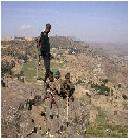
Set on a 3,000 metre high escarpment, in the rugged highlands of Wollo in Northern Ethiopia, home of the Orthodox Christian Amhara people, are the stunning locations of Mequat Mariam and Wajela.
These two communities, both dependent on ox-drawn plough agriculture that has not changed in over a thousand years, are home to some of the most hospitable people you could ever meet.
Staying in these local communities will give you a window into their ancient world, their churches, and their way of life. Walk through the age-old agrarian landscape. Follow the escarpments watching birds of prey soar in the thermals and Gelada baboons scramble across the cliff face. Talk with local shepherd boys keeping an eye on their flocks, while their fathers plough the fields and their sisters collect water in clay pots – all without another tourist in sight.
In the 4th century AD Christianity came to Ethiopia and an amazing period of church construction began which culminated in the incredible rock-hewn churches in Lalibela. In the basalt mountains around Lalibela, a local NGO - Tourism in Ethiopia for Sustainable Future Alternatives (TESFA) - is assisting local communities to set up and manage trekking facilities that enable you to see the ancient culture of the Amhara people. (Two are fully operational as of October ’05, others are being developed). It is easy to combine a two or three day trip to these mountains with your visit to Lalibela.
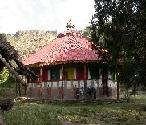
Stay in clean, comfortable, eco-friendly accommodation in keeping with the surroundings. The tukuls, simple local cottages, are constructed and furnished using local styles and materials where feasible. Simple but tasty food to suit western palates is served.
Location :
Mequat Mariam and Wajela sites are in Meket Woreda, the neighbouring district to Lalibela, home of the 11 rock-hewn churches built in the 12th century. Ideally tourists fit in a trip to Meket on the way to or from Lalibela (2 hours by car). Local buses operate from most regional towns driving through Meket, although progress can be slow and uncomfortable. Hiring 4x4 landcruisers is a good (although not cheap) way to get around. They can be rented privately from Lalibela at a pre-agreed rate of around $80-85 USD each way to and from Meket. For Meket to Bahir Dar or Gondar the charge will be approx $180 USD.
Contact
Mark Chapman
C/O Save the Children UK
PO Box 7165
Addis Ababa, Ethiopia
Tel : +251 1 14 05 3 / 23 38 40
Mobile +251 9 41 64 52
E-mail : Chapman@ethionet.et
As well as C/C to :
Mark.cassandra@gmail.com and
info@community-tourism-ethiopia.com
Internet : www.community-tourism-ethiopia.com
Language : English
Alternative contact
TSD Travel, Dawit or Seble
Email : tdstravel@ethionet.et
Tel : +251 1 61 00 83
Cultural & background information about the community :
The communities in this part of Highland Ethiopia, Amhara people, are predominantly Orthodox Christian (a unique church that has developed along its own lines for over 1,600 years). Their adherence to this faith affects every part of their life. Some feel it gives them the strength and dignity to face their lives which are very harsh. After so many centuries of habitation, every foot of the land is under the plough or protected by the church and the biggest problem that people face is that their land can no longer provide them with enough to survive a year, and so over the past two decades vast amounts of food aid have been pumped into the area. The Holy Grail is now a search for alternative livelihoods to enable communities to gain an income from non-agricultural sources. Community tourism is one possible answer.
All land is owned by the state, farmers have a user-right over a piece of land but are only too aware that this could be taken away from them at anytime. This has the effect of locking the farmers to the land as they can’t sell their land to raise capital for any other endeavour. Within the community the development of the Community tourism sites has created much discussion about land as the land the site is to be built on would have had a previous use and in all likelihood user. The issues around this related to compensation are issues TESFA has helped the community to work out.
Culturel Events :
The big festivals in the Orthodox calendar include ‘Timkat’ – often referred to as Ethiopia Epiphany but in fact this is the celebration of Jesus’ baptism by John – celebrated on January 19th. On the eve of Timkat at around 2pm processions leave all churches to head for the Timkat sites – in rural communities this is the local stream and meadow. It is done with great pomp, and the ‘Tabot’ or replica of the Arc of the Covenant – the one time in a church that makes it holy, is at the centre of the procession, born aloft by priests in magnificent robes with brocaded umbrellas. There is liturgical singing and beating of the great drums. One is reminded of the story of King David dancing the Arc of Covenant into Jerusalem. The Tabots camp out overnight at the meadow, and next morning after much prayer and chanting there is an explosion of joy as youths leap into the water and splash everyone ! There is then the return procession for all except tabots of Mikael (St. Michael) who celebrate their Timkat the following day and then have their return procession.
Bear in mind that from just before Ethiopian Christmas (January 7th) until just after Timkat, all tourist towns in the north of Ethiopia are packed.
Ethiopian Easter is also a busy time and there are processions and special services, especially at Lalibela. This is the same date as all Orthodox churche’s Easter.
Other cultural events include sports played around holy days eg : ‘Guks’ a spear wielding horseman chasing one defending with a shield, and ‘Guna’ (around Christmas) an indigenous form of hockey.
Do you have a code of conduct, some recommendations published and disseminated by the community or some messages you want to convey to the visitors ? (prior to the trip : dress, photography, cultural beliefs..)
Yes there is, please ask for further information
Recommended Tours :
Target : Small groups ideal size 4-6, (not ideal for small children – cliff faces can make people nervous). It is more expensive to run for individuals and due to transport problems can be harder for them to come. Sites at the moment have 4 beds in two rooms, but this is being expanded to 6 beds in 3 rooms. TESFA aim to accommodate a maximum group size of 6-8 per site. Bigger groups could split into different sites.
Trekking is the main activity, although cultural interaction on a larger scale can easily be arranged. All guests should be fit and healthy, the altitude is 2,800meters, and the trekking while mostly on the flat needs some fitness. Our oldest visitors to do the full walk were in their mid 60s. Local horses (with local tack) can be arranged for a small additional fee (tall or people over 85kgs, may not be able to ride as local horses are small).
Recommended seasons : July-September we are closed for the rainy season. Mid October until late November is wonderful for flowers, birds and butterflies. December and January are good for seeing harvest landscapes.
Types of tours provided : Overnight accommodation to fit your preferences. Minimum is one full day, one overnight and an early pickup. It is possible to have 2 nights in one community to spend more time visiting with local people. Current maximum (without double nights in one site) is three full days and two nights, however this is being expanded and be more sites available soon (check the website). Assistance can be provided in organising bookings for your trip around the neighbouring tourist sites of Lalibela, Gondar and Bahir Dar.
Guide : a guide with a good command of English will accompany the tourists on their trip, and local community guides will assist too, although they will have very limited English.
Porters : luggage will be carried by porters or most likely by donkey so please use soft bags for your luggage where possible.
Horses available as optional extra.
Price : Approx USD35.00 per person/ per 24 hours (charge in Ethiopian Birr) please see website for further details.
Short description of the services offered :
1. Accommodation (comfortable beds, linen, blankets etc)
Full board
2. Breakfast (eggs, fresh local bread, honey, with tea or coffee),
3. Picnic enroute with a local style ‘lunch box’ of enjara and shiro (local bread/pancake with an Ethiopian lentil paste) and more of the fresh bread
4. Snack on arrival at the site which might be roasted grains and crisps, or a local version of a pizza ! Tea or coffee will be prepared too.
5. Dinner is served to suit European palates – stew with rice, or spaghetti and sauce (and can be vegetarian if tourists require it)
6. A sheep can be slaughtered if the tourists wish, but this costs a little extra
7. Bottled drinks are always available – water, beers, soft drinks, and sometimes wine, gin and tonic etc.
Tour Offered :
Day 1 : 10.30am Leave Lalibela by jeep, meeting your guide at Ararat Restaurant for a local lunch of Tibbs & Enjara at 12.30pm. (If you leave Lalibela earlier you can have a longer trek.)
2.00–3.30pm Spectacular walk to the village of Wajela. After arriving at the site you can make a steep but short descent down to the local church of Werketa Mariam and beyond it, the intriguing cave structure.
Day 2 : Walk to Church of Kura Anbessa Giyorgis (approx 1 hour). On the way passing local water sources near Wajela and basalt rock formations in the river bed near the church. The wooded churchyard has great views to the south.
A wonderful escarpment walk allows time to stop and watch birds soaring, appreciate the views and talk with the local farmers, maybe having a go at ploughing or threshing. At about 4.30pm you should reach the site at Mequat Mariam- a truly magnificent location – in time for drinks on the cliff before sunset on the special rock bar. Don’t drink too much – there is a big drop !
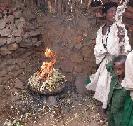
If early enough (it chills down as the sun goes down) a warm shower should be possible for some guests (the sun is used to heat the water so if it is not sunny it is not warm). A camp fire can be lit for drinks after dinner underneath the stars with your hosts. We recommend that you take the chance to learn about their life, and be ready to answer their questions. Brad Pitt and his entourage got a surprise when his hosts did not know what America was !
Day 3 : A two to three hour walk takes you to the Juniper forest at Werkhaye Mariam. This is on a rough road about 15 minutes out of Filakit the local town and is where your vehicle will rendezvous with you to take you back to Lalibela or on to Bahir Dar or Gondar.