


Text and Photo : Tony Donovan
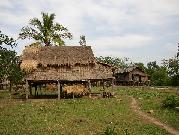
I woke up this morning feeling a little tired, but exhilarated, as result of the previous evening’s activities. After participating in a traditional “Baci” ceremony to bring good luck, trying tasty local foods and drinks and enjoying some traditional music and singing, I had slept in the home of a Katang (ethnic culture) family in Ban Vong Si Keo Village. I even mastered a smattering of the local language and relished the opportunity to practice my newly acquired communication skills with the village headman and other inhabitants. Learning about the culture of the Katang people was a wonderful experience. I particularly enjoyed hearing about the complex traditional courting rituals.
Having spent the previous day trekking through the jungle and learning about the plants and animals along the route, from our group’s local guide, I felt that I had truly come to understand the importance of the forest to the lifestyles and economies of the local people. It was fascinating to see the range of products gathered in the forest and their uses – everything from food to medicine, fuels to raw materials for craft production. Having the chance to gather some herbs and bush fruits and add them to my dinner was an added bonus that I look forward to telling my friends about when back at home.
As the sun rose, I was eager to begin the walk to the Dong Sa’Kee sacred forest. With a little luck, I might even see some rare silvered langur monkeys and some hornbill birds along the way. Khaisy, our guide, had promised to explain why the forest is considered sacred by the local people, and there would also be a chance to examine the “Lak La’puep” wooden clan posts – an important part of burial rites for the Katang people. As Khaisy had explained, in Katang culture the dead are buried in the forest. After a period of time – usually 8 or 15 years – the La’puep ritual is organized. Some soil is removed from the grave, sprinkled around the base of the post and a sacrifice is made. During the ceremony, food is left near the post, the spirit of the dead ancestor is invited to eat and to come and guard the house of the family. In this way, the ancestor’s spirit becomes the house spirit.
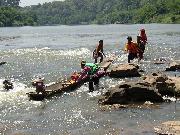
Yesterday’s experience was a tough act to follow but I thought that today might be even better. I was really looking forward to the trip by long-tailed boat down the Xe Banghieng River to the Kaeng Saammatek Rapids. My interest had been piqued by the story of how the rapids were named. A long time ago, a rich trader, carrying a lot of treasures, was riding his elephant when suddenly they were chased by a tiger. The elephant ran into the Xe Banghieng River, died and became a rock. The tiger got washed further down the river where he also died and became a rock. The trader, who was the only survivor, gathered all his treasures and put them in some big pots. Then, he built a raft by tying three logs together, put the pots on it and started traveling down the river. When he arrived at the rapids, the raft broke on the rocks and all his treasures were washed away. And this is why the rapids were named Kaeng Saammatek – literally rapids (kaeng), three (saam), tied together (mat), broken (tek). Perhaps, there might be time for a little treasure-hunting in the water below the rapids !
Yes, today is going to be a very exciting day.
Location
Savannakhet Province is ideally located in the centre of the Lao Peoples Democratic Republic. It is bordered by the Socialist Republic of Vietnam to the east and the Kingdom of Thailand to the west. Directly north is Khammouan Province, while to the south is Saravan Province.
Thanks to its location in the centre of the country, Savannakhet City is very accessible from all directions, for example :
From the north, it is situated 495 km south of Vientiane, along route 13 ;
From the south, it is situated 247 km north of Pakse, along route 13 ;
From the west, it is situated 241 km east of Lao Bao – the Lao/Vietnam border ;
From the east, it is directly across the Mekong river from the Thai town of Mukdahan. _ There are regular ferry crossings during the day. A bridge linking the two cities is scheduled to open in 2006.
Contact
Savannakhet Eco-guide Unit
P.O. Box 905, Savannakhet, Lao PDR
Tel. :+ 856 41 214 203
Fax :+ 856 41 212 755
Email :
savannakhetguides2@yahoo.com
Internet :(under construction) Savannakhet
SNV Laos website (www.snv.org.la)
www.ecotourismlaos.com
Language : English
Please note that access to the NBCA for trekking is restricted to approved treks lead by the Savannakhet Eco-guide Unit.
Cultural Information
Savannakhet Province – sometimes referred to as the crossroads of south-east Asia – is located in the centre of the Lao P.D.R. Formerly, the province was known as “Souvannakhet” – souvan means gold and khet means territory – the Golden Land. The provincial capital is Savannakhet City (Muang Khanthabouli) on the bank of the mighty Mekong River – a relaxing city with charming French colonial architecture, peaceful wats and interesting museums. The province contains two National Bio-diversity Conservation Areas (NBCA) known as Dong Phu Vieng and Phu Xang Hae, as well as a Provincial Conservation Area (PCA) called Dong Natad.
Dong Phu Vieng, covering an area of 197,000 hectares is a National Bio-diversity Conservation Area since 1995. There are 36 villages situated inside the NBCA and a further 39 villages in the area surrounding it. The area contains two sizeable mountains, namely, Phu Lapeung-Nua (1122m) and Phu Dotoy (1254m). It comprises primarily dipterocarp woodland as well as evergreen forest. Some of the animals that have been recorded in the area include : Primates (pig-tailed macaque, douc langur, silvered langur and crested gibbons) ; Asian elephants ; Gaur or Asian bison ; Elds deer ; Various species of bears, otters, cats and pigs. There is also a variety of birdlife, including : Hornbills (pied hornbill, great hornbill and wreathed hornbill) ; Vultures (white-ruped vulture, red-headed vulture) ; Various others, such as, plovers, eagles and red-wattled lapwings.
Recommended Tours
Name of the Tour :“Katang Trail to the Sacred Forest”.
Length of the Trip:Three days
Departure Dates:The trek is offered daily subject to demand.
Season:This trek is offered during the dry season which extends from December to May. (Alternative treks in other areas can be offered during the period from June to November.)
Included:Hotel/Guesthouse pick up and all transportation. Provincial and village guide service. All meals and accommodation during the trek. Drinking water during the trek. Contribution to conservation and development funds. All taxes and service charges.
Excluded:Travel to Savannakhet City from other parts of Lao PDR.
Type of Accommodation:Village home-stay
Type of Services:Savannakhet EGU and village guides. Traditional entertainment and story-telling in villages. Listening to the music of the countryside created by the birds, insects and animals ; Visiting the Dong Sa’Kee forest and cemetery and learning why it is considered sacred by the local people ; Examining and understanding the “Lak La’puep” wooden clan posts which give an insight into Katang burial traditions ; The possibility of encountering monkeys (silvered langur) and birds (hornbills) ; Seeing and learning about traditional village methods and crafts, including silk production, weaving and blacksmithing ; Experiencing a traditional Baci Ceremony as practiced by Katang people and having the opportunity to talk with people and understand the local culture.
Staying in the home of a Katang family in Ban Vong Si Keo village and tasting traditional foods and drinks ; Learning some of the stories about the rock formations such as “rocky rhinoceros” ; Riding the long-tailed boats from Kaeng La’berng rapids to Kaeng Saammatek rapids and observing birds and animals along the river bank.
Booking:Refer to Contacts above.
Group Size:Minimum three people ; maximum ten people.
Age/Fitness Requirements:The trek is suitable for visitors of all almost all ages, with a reasonable level of fitness. No previous trekking experience is required.
Type of Weather:Dry Season. Temperature Range – 20 to 35 degrees celsius
Specific Recommendations:Shoes for trekking (runners are acceptable). Sunscreen, insect repellent and hat. Camera and binoculars, if you have them. Small backpack. Toiletries such as soap, shampoo and a towel. Sarong for bathing (for women). Waterproof (plastic) bag to protect valuables during the boat ride.
Organization
The trek is operated by the Savannakhet Eco-guide Unit – an initiative of the Savannakhet Provincial Tourism Office. The unit was formally established in 2004 as an independent organization of trained eco-tourism guides with two full-time employees who take responsibility for Administration/Finance and Marketing/Promotion. The activities of the EGU are monitored by the Savannakhet Provincial Eco-tourism Steering Committee, which is made up of representatives from the major stakeholder groups regarding tourism development in the province.
The purpose of the EGU is to manage and promote the various trekking trails in the protected areas of Savannakhet. Therefore, it plays a key role in the further development of eco-tourism in the province, making a significant contribution to controlling the socio-cultural and environmental impacts of tourism and improving the economic situation of the villages within the protected areas.
The work of the EGU is supported by SNV Netherlands Development Organisation. Two eco-tourism advisors – one national and one international – have been assigned by to work in the province. SNV is an international development organisation that provides advice to local organizations in developing countries. SNV supports eco-tourism as a mechanism for bringing economic benefits to communities, while minimising the negative impacts of tourism in order to ensure that the development of the industry is sustainable.